GamesRadar specializes in providing cheat codes for GBA games such as CT: Special Forces 3: Bioterror. Also find reviews, previews, features, news and more
Intelligence agencies are mentioning an increase in terrorist activity in every nook and cranny of the planet. The secret services are in a decidedly uncomfortable spot, given the latest resounding failures. The CT Special Forces unit will once again be called upon to diffuse a series of conflicts that have democracies around the globe highly concerned.
Armed with high-tech weaponry and cutting-edge equipment, you'll need to thwart the plans of terrorist groups and ensure peace in several regions of the world. The combat support offered by two helicopters will be far from superfluous.
Originally titled "Chitty Chitty Chicken" in its native Japan, Crossroad Crisis is exactly what a puzzle game should be: simple, easy to learn, and immediately addictive. It combines strategy with quick thinking and fast reflexes, but doesn't overwhelm the player with its frantic pace too early on.
The only thing holding it back from being a classic is a lack of variety. There are only ten stages, and apart from faster speeds and a higher number of tiles to clear, each one is exactly the same. But the small amount of levels doesn't make Crossroad Crisis a breeze to finish. After the fourth stage, each one begins to pose a real challenge. Just don't expect the game to throw anything new at you as it progresses. A variety of board sizes and additional tile colors would have gone a long way to increasing difficulty without merely making the game faster.
As with most puzzle games, Crossroad Crisis doesn't excel in the visual department, but the graphics are bright and cute and never interfere with the gameplay. Each tile is clearly recognizable, as is the direction the chick is walking. The music fits the colorful mood of the game, and the audible warning when the chick is about to fall is especially helpful. A1 Games' budget releases for the PlayStation have been hit or miss, but it's hard to go wrong with this excellent, if ultimately limited, puzzle game. In the end,Crossroad Crisis is worth every penny.
Fox Interactive's Croc: Legend of Gobbos sees its player as a genuinely cute platform hero - something I never thought I'd ever say about a video game character - who must explore a 3D Super Mario 64-like world, in search of his kidnapped gerbil-esque friends, the Gobbos.
Yep, that's right, the evil Baron Dante and his Dantini followers have stolen away Croc's pals and spread them out equally all over the world, so as to always have one around to harass if the need arises. Now it's up to you to run, jump, climb, and swim your way through 45 levels made up of forest, desert, ice, and Dante Castle stages, freeing the Gobbos from their PETA-unfriendly cages all the while. If you're really good and can make it to the secret island, there's a secret boss on a hidden island to beat, as well - making it, all in all, a handsomely sized game. It's just some of the gameplay that takes place over those levels that makes the whole thing a little questionable.
Croc can easily be seen as the sum of many previous video game parts. The character possesses the butt-stomp of Mario from Super Mario 64, the tail-spin and climbing ability of the same-named lead of Crystal Dynamic's Gex, and bits of Sega's Sonic the Hedgehog, as well. A few other games can be noticed at times, too. But that's all right if the game's fun, right? Sure, and it almost is.
Without a doubt, it's an impressive achievement that Argonaut was able to nearly emulate a Super Mario 64-style 3D environment on the Sony PlayStation, though it's less impressive that it wasn't able to imitate the game's perspective and control. The creators of SM64 knew that to be able to functionally jump from platform to platform, the default view would have to be directly above and behind the main character, and it is, or can be configured to be, about 95 percent of the time. In Croc however, the player is locked into a behind-and-to-the-side view during about half of the game's crucial moments, making jumps or even general movement far harder than they should be. In the beginning, this is far less of an issue and Croc shows off how much of an enjoyable title it could have been. But soon, moving platforms, dissolving platforms, and other such devices are added to the mix and the fun factor of the game falls off a cliff. Yes, this perspective/control problem makes it that horribly frustrating to play - even the use of Sony's Dual Analog Controller can't save it.
In the end, Croc: Legend of Gobbos is a charmingly-enough-themed platformer that just didn't live up to its potential. It ended up a Christmas holiday must-rent, when it could have been a Christmas holiday must-have.
The original Croc was graphically impressive for its time because it showed that seamless 3D platform worlds were possible on the PlayStation (something Spyro did to a much greater degree a year later). It seemed to have all the elements in place to be a great title: a cute mascot with a bevy of different moves, and elements from all the major platform games. But two fatal flaws knocked it down: The gameplay was repetitive, and lack of camera control led to numerous frustrating, cheap deaths.
The sequel, however, no longer requires you to muddle through level after level with the same exact goals to accomplish ("Free the Gobbos"). In fact, there are no longer levels, at least not in the linear sense. You now enter hub areas where you accept missions from your weepy Gobbo friends (miniature tribble-like creatures that are always in need of help). Some of the quests are similar to minigames in other games, such as a short race against several opponents in speedboats. Other missions have you collecting lost items within large environments. Granted, "Get the Sandwich" isn't essentially much different from original's "Free the Gobbos," but there's enough perceived variety so that the gameplay doesn't feel repetitive. And the hub setup lets you try out other missions without having to beat stages to progress. Another improvement is the basic inventory system, which lets you use items you find or buy, such as binoculars or high-jump Gummi Savers (hello, product placement) that let you access special areas.
Unfortunately, Croc 2 still uses the camera system that the first game did. Instead of being able to shift your perspective to the left and right using the L2 and R2 buttons (as in Spyro, Gex, and Kain), the camera eventually catches up to whichever way the character is facing. Since Croc usually takes a few steps when he turns, you'll often find yourself off a cliff or platform when you're trying to line up for a jump. It's hardly an ideal system for leaping across a series of collapsing platforms - unless they're all conveniently lined up in order.
It's also far too easy to get killed in Croc 2, perhaps even more so than in the original. Cheap deaths are everywhere due to the perspective problems, as well as the fact that health power-ups (or hearts) are far too few and far between. Falling into lava or similar hazards causes you to start up at the last checkpoint, which is all well and good except that you begin without any life energy. That thing that gave you trouble when you had a full life? Well, now you can try again with none at all.
Instead of subscribing to the Super Mario 64 way of teaching players how to overcome obstacles (where the player learns new moves gradually along the way), the Croc series expects you to learn by dying, and since you frequently lose lives because of the camera, you get mixed messages, which leads to frustration and consequently to turning the game off. One bit of redemption comes in the form of those aforementioned side games in which you'll find yourself zipping through tunnels on a mine cart or flying through loops Prop Cycle-style without the cycle. While these new tricks hardly save the game, they do break up the morbid monotony of falling off platforms. All in all, if Croc 2 had learned its perspective lessons and it wasn't so easy to get killed in the game, it'd end up at par with or perhaps even above games in the Crystal Dynamics' Gex league. It held promise, but once again two fatal flaws hold it down.
Sorry to say this without much of a softening up speech, but Crash Bandicoot is the most see-through, copycat mascot that ever existed, and he's once again ripped off a game concept from another mascot. He stole Sonic's hip, brash personality and Mario's ideas, and now, I'm coincidentally sad to say he doesn't even belong exclusively to the PlayStation or PS2. But I digress (already!). His latest venture, Crash Bash (clever double entendre implied) follows up on Crash's five-game PlayStation spree, and approaches the Mario Party concept by adding enough polish and county glimmering fair gaming qualities that make this game hard to resist.
Gameplay
Despite it's complete lack of originality, Crash Bash is a totally fun party game, and one of the few of its kind on PlayStation. How can I have so much contempt for Crash yet still like the game? It's not easy, but videogames have many layers, and Crash Bash is like spiked punch -- it's perfect for a party, as long as you own a multi-tap.
Crash follows Mario Party right down the line, and I liked Mario Party. It was a light, board game fun that was great for four people. Many of the games were luck-based and a few were skill-based, but it was like going to the county fair. It's distracting and social and you even up kind of liking it. So... If Crash Bash is Mario Party with different characters, then the only thing to hold me up from liking Crash Bash is whether or not Sony and Eurocom trashed the game concept, right? Luckily, they didn't.
Crash Bash sets gamers up in the familiar Crash universe, in which Crash and his buddies all fight against one another in 30 events that span seven "levels." In Adventure mode, the game strips out the whole game-board concept and just plops you into a menu system. Players pick a game and then fight against three other characters in five to seven minigames in each of seven warp zones. Players win gold cups, gems, and another stone to progress in each Warp Zone before they face off against a Boss. By beating the Boss character in a unique minigame, Crash earns the right to warp to a newer, more intricate set of games. What's quite nice about the game is that despite the repetitive nature of minigames such as Crash Ball, in each level the game is modified into a slightly altered, more dynamic battle. In Warp Zone 2 Crash Ball vehicles have magnetized bumpers and can control the ball, whereas in level 1, they couldn't. It's touches like this that make Crash worth all of the repetition. What's more, you'll get quite good at it in the single-player mode and then you'll have an edge over your buddies when you play in Multiplayer mode.
What makes Crash Bash and games like it so different and, in many ways, more accessible than standard videogames is the blend of luck and skill. Half of the time when you die, it's just bad luck, and the other half it's because you learned what not to do. There is no videogame experience required.
The star characters include Crash, Coco, Dingodile, Tiny, Neo Cortex, and Neo Brio, plus two unlockable characters. The minigames range from twitch games, such as Crash Ball, which is sort of like pinball; Smash-'em-up games, such as Polar Panic, in which each character rides a polar bear and they attempt to smash each other off an iceberg arena, and variations of last-one standing and high-point games. Space Bash (among others) is very reminiscent of Bomberman, since characters pick up and throw, or kick, boxes at one another to remain the last one standing. Another Bomberman spin-off is Desert Fox -- characters shoot each other from miniature tanks in a square grid to see who can stay alive the longest.
The other mode is Battle. Players can go head to head in a four-way competition, or they can team up in two-on-two fights. Battle is the heart of the game, and can keep you glued to the game for hours -- as long as you're in a light mood. There is no big story here, there is no complicated battle system, and there certainly aren't any massive fantastic graphic effects -- there are just lots of competitive, adrenaline-pumping minigames. So, if you're in the party mood, Crash Bash is your bag, baby.
Crash Bandicoot started life as Sony's attempt at a mascot. He did reasonably well but never quite caught on like Mario or Sonic. But regardless of his status as a mascot, Crash has always managed to make a good game. In Crash Bandicoot 3, the evil Dr. Cortex is up to no good yet again with a new band of henchmen for you to defeat. This time the game takes place across a great expanse of time and space, making for greatly diverse level designs, which in turn keep the game fresh.
The 30 different levels are mostly composed of the same 3D platform-jumping obstacle-evading Crash levels that we're used to. Some levels, however, allow you to take control of vehicles such as a biplane, motorcycle, or Jet Ski. These levels are almost like little minigames that spice up the action and break up the monotony.
As before, when you go through the levels you are rewarded with crystals and gems. In Crash 3, you can also collect a relic for beating a level within a certain amount of time. Also new to the third game is the ability to learn new moves upon defeating a boss. Abilities like the super belly flop, double jump, super spin, and super run definitely help you to get through the levels faster. These moves will also help you unlock secret levels.
Visually, Crash 3 is flawless. The smooth character animations and bright, colorful landscapes make the game look like a cartoon. Amazing attention to detail and gorgeous lighting effects give torches, lasers, and other illuminating objects in the world a life of their own. All of this along with a refreshingly fast and steady frame rate easily makes Crash 3 one of the most beautiful PlayStation games ever.
Crash 3 even delivers in the audio department. It has outstanding music, sound effects, and character voice-overs that are not only extremely well done, but the onscreen lip-synching is almost perfectly matched to the voice.
In the end, Crash Bandicoot 3 is easily the best Crash yet. Every aspect of the game is better: new moves, levels, bosses, graphics, sound, and gameplay. It's the most fun I've had with a 3D platform game in a long, long time. It's a must-have for fans of platformers
Crash Bandicoot 2: Cortex Strikes Back is the obligatory sequel, and while it isn't a major departure from the first game, it has been infused with plenty of new elements to make it worth checking out.
Crash can flip. He can spin. He can slide. He can crawl. He can even land flat on his face if you so desire. And, above all, he can amuse you for hours. Crash Bandicoot, a new game for ExEn phones, rocks my world. The gameplay is tight, the graphics are pretty, and the replay value is high. Every now and again, a game draws me in so deep that I'm forced to play it for a disgusting amount of time. This is one of those games.
Crash Bandicoot spans 18 levels over four distinct worlds, making it the longest game for ExEn. Despite its length, Crash Bandicoot is never a chore to play because its gameplay is just awesome. Most of the levels consist of collecting apples, Crash's food of choice, and jewels, two of which are to be found in each level. In addition, Crash must avoid obstacles, such as endless pits and the TNT crates that populate each level. TNT crates, like almost anything that violently explodes, can be used as a tool but can also be deadly. Often, Crash must jump onto TNT crates in order to reach higher areas of the levels, triggering the three-second explosion timer in the process. Sometimes Crash must purposely trigger the TNT crates in order to get past them. You also have to watch out for the "giant exclamation point" boxes. Hitting these boxes causes other boxes, which were previously only phantom outlines, to appear. Sometimes a TNT box must be used to trigger an exclamation point box.
Although there are numerous baddies throughout the levels, the main challenge for Crash is to collect goodies without accidentally falling into one of the endless pits or landing on spikes. In terms of falling into pits and being impaled, the game is totally unforgiving. You'd think that they might have been able to meet you halfway on the bottomless pits, but no such luck. There is no respawning or extra lives in Crash Bandicoot, making it, despite the cartoony graphics, more realistic than most first-person shooters. With so many goodies to collect, the challenge is to play a perfect game, not just to survive. Even after completing the game, you'll want to go back and find all the jewels and apples you missed in each level.
Crash's graphics are beautiful. The game's backgrounds are terrific, if a bit repetitive. Each of the four worlds has its own unique look to go with its unique gameplay features. For example, the second world, Aku, looks like an Aztec city replete with huge statues of deities, whereas the third world, Uka (Aku spelled backward for whatever reason), is mountainous, icy, and full of moving platforms.
Crash Bandicoot is a really rewarding experience. As Ferris Bueller said of his limited-edition 1969 Ferrari, "If you have the means, I highly suggest that you pick one up." Though somewhat dated at this point, it's certainly the best game available for ExEn and is a killer mobile title overall.
When a game like Crash Team Racing arrives on the kart scene, you know the videogame industry has grown fat and happy. In every way better than any of the next-generation kart games, CTR is also the most unoriginal, from its structure to its characters to its powerups and courses. This game reeks of Nintendo's Mario Kart 64 and Diddy Kong Racing in every facet, and yet if you can push aside the maniacally smiling, pasted-on smile of Crash bursting across the finish line, then you will like this game. To be fair, Naughty Dog has integrated its usual technical magic by making CTR good-looking, fast, and four-player.
Cowboy Bebop is a scrolling shooter which bears striking similarities to Star Fox for the Super Nintendo Entertainment System (Super Famicom). The player controls Spike Spiegel's Swordfish II from a third person perspective. Each level involves chasing another ship (the bounty head) along a set track through different environments, while enemies (spaceships, robots, etc.) attack. Each stage ends with a boss battle, confronting your target.
Between stages, bonus points earned can be spent to purchase upgrades for the ship (faster speed, more powerful ammo, stronger laser).
Covert Ops: Nuclear Dawn can be written off as a survival-horror game sans the horror: In place of unholy biological mutations, you have fanatical terrorists crawling around a cramped bullet train.
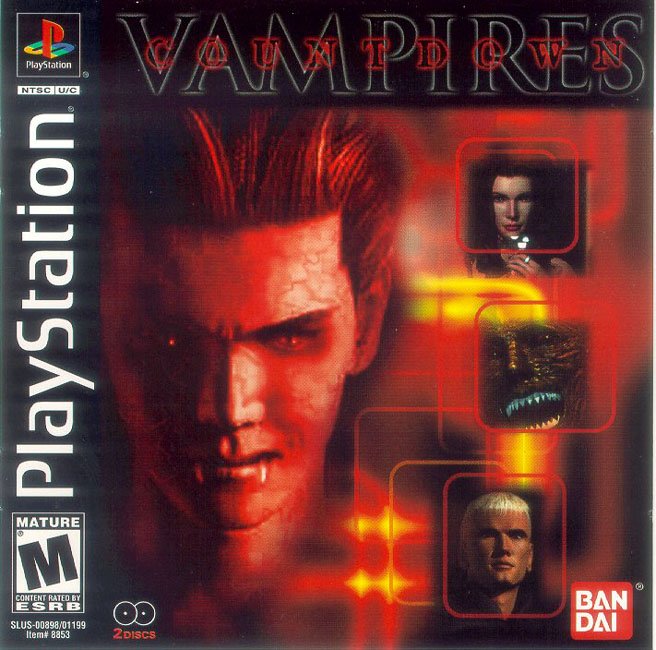
Countdown vampires is not exactly a bad game, although I do not by any means want to play it again. It does a few things right, and what it does wrong is nothing that Resident Evil hasn't done wrong while still selling millions of copies worldwide. But therein lies the main problem with Countdown Vampires - it is, in just about every way you can think of, a poor man's Resident Evil, to the point that it even shares Resident Evil's lingering fundamental design flaws. Thus, it irritates me in the same way that Resident Evil does, while at the same time failing to make up for that in the way Resident Evil does, at least during its better moments.
This is not to say that Countdown doesn't pique my interest in a few areas. For one, I wonder why it takes place in "Casino City." It's very obviously supposed to be Las Vegas...so why not call it Las Vegas? Does the chamber of commerce or the city tourism bureau levy some sort of fee for use of the term in a fictitious setting? Or did the game's developers fear libel complaints, in case someone took offense at the intimation that the city was infested with vampires? Whatever the reason, it's Casino City, and you're Keith J. Snyder, detective on the clock and bodyguard after hours, protecting assorted VIPs at the opening of a horror-themed casino. Like clockwork, something goes horribly wrong - go-go dancers start turning into vampires, innocent gamblers go down in a froth of carotid spray, and you're suddently on your own to survive the horror however you can.
Gameplay
This you do with only your trusty anaesthetic gun, a handful of snack foods, something called "White Water," and no shirt, since Keith decided to attend a fancy dress occasion in just a trench coat, pants, a swank set of blackwork tattoos, and a nifty pair of shin guards. Ours is not to question why. That anaesthetic gun is part of one of the game's more interesting concepts, though. See, these are all innocent people who've been turned into vampires, and so morality dictates that you shouldn't kill them stone dead unless absolutely necessary. You can neutralize them nonviolently with the anaesthetic gun, taking them down with several shots and then dousing them with the White Water, which turns them back into humans.
A bit of a flaw appears in this system as soon as you discover another weapon, though. Given the choice between taking down a vampire with about five darts, waiting for them to get up, pumping another three or four into them, and then going over to douse them, or alternatively blowing them away with one 12-gauge slug, after which they conveniently fade into nothingness, which would you pick? Nonviolence is all well and good, but efficiency is even more prized when you just want to make it to the next locked door and get on with things.
That's how Countdown Vampires progresses, more or less. Kill vampires. Find key. Go to locked door. Open locked door. Repeat. It's mainly a matter of picking through every corner and making sure you don't miss any vital items. If you do miss one, there'll be hell to pay, as you thrash around violently trying to figure out what you missed - you'll wind up exploring every nook and cranny of the explored sections of the map, trying to find the little box that escaped your eye or the safe that you forgot to open up. The puzzles you encounter are generally very basic, requiring only the application of an item or the completion of a simple brain-teaser (although I quite liked the System Shock-style safe lock puzzles). When you do encounter more difficult puzzles, some of them can be engaging, but others are unneccessarily frustrating - it's not much fun to encounter a puzzle that's made difficult not by the sheer complexity of it, but by the fact that the instructions are too indistinctly translated from the Japanese.
Combat, on the other hand, is not that difficult at all, once you remember how to compensate for the inherent clumsiness of Resident Evil's control style. Yep, you still turn on a dime - nobody's introduced Keith to the concept of sidestepping. He does, however, automatically aim at the nearest enemy when you switch to the R1 firing stance, which is a nice touch - it makes dealing with hordes of onrushing vampires quick and simple, especially when you're packing that way-cool shotgun. Item management, the other common problem in survival horror games, is actually not so much of a problem in Countdown Vampires, thanks to a decently-sized inventory and some nice storage innovations. I mentioned snack foods in the beginning there as one of your only assets - they're what you use to refill your life, sports drinks and granola bars and so forth (hey, it's just a game). The nice thing about the drinks is that you can store up to three in a bottle item, freeing up inventory space and creating one powerful healing item instead of a bunch of dinky ones.